
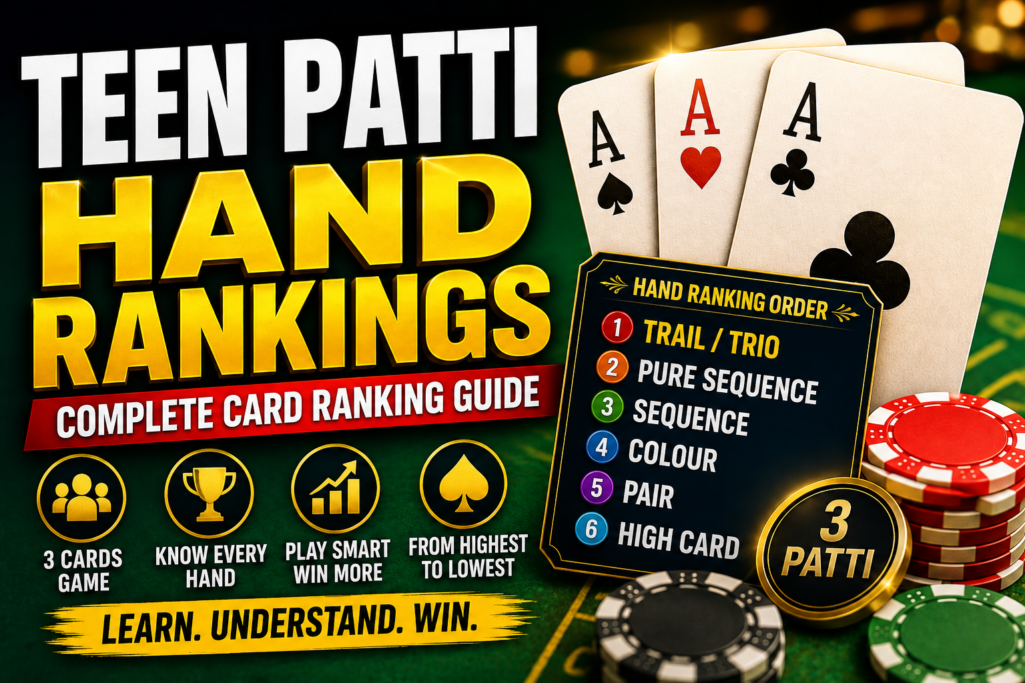
Understanding Teen Patti hand rankings is one of the most important things to learn before playing the game. Every player receives three cards, and the strength of those three cards determines the outcome when a showdown takes place.
Teen Patti, also known as 3 Patti, uses a simple ranking system. The strongest hands are placed above weaker combinations, with a Trail or Trio generally ranking at the top in the standard version.
Whether you are completely new to Teen Patti or want to refresh your knowledge, this guide explains every major hand from highest to lowest, with examples and easy explanations.
Important: Different Teen Patti apps and variations can modify card rankings or special-hand rules. Always check the rules displayed by the particular game or table before playing.
Teen Patti Hand Rankings at a Glance
In standard Teen Patti, the commonly used ranking order is:
- Trail or Trio
- Pure Sequence
- Sequence
- Colour
- Pair
- High Card
Here is a quick comparison:
| Rank | Teen Patti Hand | Example | Strength |
|---|---|---|---|
| 1 | Trail / Trio | A♠ A♥ A♦ | Highest |
| 2 | Pure Sequence | 9♥ 8♥ 7♥ | Very High |
| 3 | Sequence | 9♠ 8♥ 7♦ | High |
| 4 | Colour | A♥ 9♥ 4♥ | Medium |
| 5 | Pair | K♠ K♥ 5♦ | Low |
| 6 | High Card | A♠ 9♥ 4♦ | Lowest |
The exact treatment of certain Ace combinations can vary between versions, so check the table rules when necessary.
What Are Teen Patti Hand Rankings?
Teen Patti hand rankings determine which three-card combination is stronger when two or more players compete for the pot.
Unlike games where players receive five cards, Teen Patti gives each player only three cards.
The cards can form different combinations, including:
- Three cards of the same rank
- Three consecutive cards of the same suit
- Three consecutive cards
- Three cards of the same suit
- Two cards of the same rank
- Three unrelated cards
The strongest qualifying combination wins according to the rules of the game.
1. Trail or Trio
A Trail, also called a Trio, consists of three cards with the same rank.
Examples include:
- A♠ A♥ A♦
- K♠ K♥ K♣
- 10♠ 10♥ 10♦
- 7♣ 7♦ 7♥
A Trail is generally the highest-ranking standard Teen Patti hand.
How Are Two Trails Compared?
If two players both have Trails, the rank of the three matching cards is compared.
For example:
A-A-A beats K-K-K.
Similarly:
K-K-K beats Q-Q-Q.
The higher-ranked trio wins.
Because three cards of the same rank are relatively uncommon, receiving a Trail is a very strong hand in standard Teen Patti.
2. Pure Sequence
A Pure Sequence consists of three consecutive cards belonging to the same suit.
Examples:
- 9♥ 8♥ 7♥
- 8♣ 7♣ 6♣
- K♦ Q♦ J♦
Both conditions must be satisfied:
- The cards must be consecutive.
- The cards must belong to the same suit.
A Pure Sequence is generally ranked below a Trail but above an ordinary Sequence.
Example of a Pure Sequence
Suppose your cards are:
7♠ 6♠ 5♠
These cards are consecutive and all belong to the spade suit.
Therefore, they form a Pure Sequence.
What Is Not a Pure Sequence?
Consider:
7♠ 6♥ 5♠
The cards are consecutive, but they are not all from the same suit.
Therefore, this is an ordinary Sequence rather than a Pure Sequence.
3. Sequence
A Sequence, also called a Run, contains three consecutive cards.
Unlike a Pure Sequence, the three cards do not need to belong to the same suit.
Examples include:
- 10♠ 9♥ 8♦
- 7♣ 6♥ 5♠
- K♦ Q♣ J♥
The important feature is that the card ranks form a valid sequence.
A Pure Sequence is normally stronger than an ordinary Sequence.
Pure Sequence vs Sequence
Consider these two hands:
Hand A: 9♥ 8♥ 7♥
Hand B: 9♠ 8♥ 7♦
Both contain consecutive cards.
However:
- Hand A = Pure Sequence
- Hand B = Sequence
Under standard rankings, the Pure Sequence is stronger.
4. Colour
A Colour consists of three cards from the same suit that do not form a sequence.
For example:
A♥ 9♥ 4♥
All three cards are hearts, so they form a Colour.
However, they are not consecutive, so the hand is not a Pure Sequence.
Other examples include:
- K♣ 8♣ 3♣
- Q♦ 7♦ 2♦
- J♠ 9♠ 4♠
How Is Colour Compared?
When two players have Colours, the cards are generally compared from highest to lowest according to the applicable Teen Patti rules.
For example:
A♥ 9♥ 4♥
would normally be stronger than:
K♥ 9♥ 4♥
because the highest card is an Ace instead of a King.
If the highest cards are equal, the next card can be used for comparison.
5. Pair
A Pair contains two cards with the same rank and one different card.
Examples:
- A♠ A♥ 7♦
- K♣ K♦ 4♥
- 9♠ 9♥ 2♣
The two matching cards form the pair.
How Are Pairs Compared?
The rank of the pair is considered first.
For example:
K-K-5
beats:
Q-Q-A
because Kings form a higher pair than Queens.
If two players have the same pair, the remaining card can be used as a tiebreaker according to the applicable rules.
6. High Card
A High Card hand does not contain a Trail, Pure Sequence, Sequence, Colour or Pair.
For example:
A♠ 9♥ 4♦
contains:
- No three-of-a-kind
- No sequence
- No three cards of the same suit
- No pair
Therefore, it is a High Card hand.
High Card is generally the lowest standard Teen Patti hand category.
How Are High-Card Hands Compared?
The highest card is compared first.
For example:
A-9-4
would normally beat:
K-10-7
because Ace is higher than King.
If the highest cards are equal, the next-highest cards can be compared.
Complete Teen Patti Ranking Order
For quick reference, remember this order:
Trail → Pure Sequence → Sequence → Colour → Pair → High Card
A simple way to memorize it is:
Three of a kind is strongest, followed by sequences, same-suit combinations, pairs and finally high cards.
Teen Patti Hand Ranking Examples
Let’s look at some example hands.
Example 1: Trail vs Pure Sequence
Player A: A♠ A♥ A♦
Player B: K♠ Q♠ J♠
Player A has a Trail.
Player B has a Pure Sequence.
The Trail is ranked higher in the standard game.
Winner: Player A
Example 2: Pure Sequence vs Sequence
Player A: 8♥ 7♥ 6♥
Player B: 8♠ 7♥ 6♦
Player A has a Pure Sequence.
Player B has a Sequence.
Winner: Player A
Example 3: Sequence vs Colour
Player A: 9♠ 8♥ 7♦
Player B: A♣ 9♣ 4♣
Player A has a Sequence.
Player B has a Colour.
A standard Teen Patti ranking places Sequence above Colour.
Winner: Player A
Example 4: Colour vs Pair
Player A: K♥ 8♥ 3♥
Player B: Q♠ Q♦ 7♣
Player A has a Colour.
Player B has a Pair.
Colour ranks above Pair.
Winner: Player A
Example 5: Pair vs High Card
Player A: J♠ J♦ 4♣
Player B: A♥ 10♣ 7♦
Player A has a Pair.
Player B has a High Card.
A Pair ranks above High Card.
Winner: Player A
What Is the Strongest Hand in Teen Patti?
In standard Teen Patti, the Trail or Trio is generally the strongest hand.
For example:
A♠ A♥ A♦
is a Trail and is normally stronger than a Pure Sequence, Sequence, Colour, Pair or High Card.
However, special variations can change the normal ranking system.
What Is the Weakest Hand in Teen Patti?
The High Card is generally the lowest standard hand category.
A High Card hand does not contain a pair, sequence, colour or trio.
For example:
A♠ 8♥ 3♦
would be classified as High Card if it does not meet another qualifying combination.
Although High Card is the weakest category, its actual strength depends on the values of the cards.
Understanding Card Values
Card values are important when comparing hands within the same category.
The commonly recognized card order is:
A → K → Q → J → 10 → 9 → 8 → 7 → 6 → 5 → 4 → 3 → 2
However, special sequences involving an Ace can be treated differently depending on the rules of the particular Teen Patti version.
For that reason, always check the game’s specific sequence rules.
Does Suit Matter in Teen Patti?
Suits are:
- Spades ♠
- Hearts ♥
- Diamonds ♦
- Clubs ♣
In standard Teen Patti, suits matter when determining whether a hand qualifies as a Colour or Pure Sequence.
For example:
8♥ 7♥ 6♥
is a Pure Sequence because all three cards belong to the same suit.
But:
8♥ 7♠ 6♥
is not a Pure Sequence because the suits are different.
Some platforms may have additional suit rules or tie-breaking systems, so their instructions should be checked.
Teen Patti Sequence Examples
Sequences can sometimes confuse beginners.
Here are some simple examples.
Example A
5♠ 4♥ 3♦
These are consecutive ranks.
This is a Sequence.
Example B
Q♥ J♥ 10♥
These are consecutive and all belong to the same suit.
This is a Pure Sequence.
Example C
K♣ Q♦ J♠
These are consecutive but have different suits.
This is a Sequence.
Example D
A♥ 9♥ 4♥
All cards are hearts, but they are not consecutive.
This is a Colour rather than a Pure Sequence.
What Happens When Players Have Similar Hands?
When two players have the same type of hand, the relevant card values are compared.
For example, if both players have Pairs:
Player A: K-K-5
Player B: Q-Q-A
The King pair is normally stronger.
If both players have the same pair, the remaining card can become important.
For other hand categories, comparison follows the rules of the particular game.
Because online Teen Patti variations may implement tie-breaking differently, don’t assume that every app handles identical hands in exactly the same way.
Teen Patti Hand Rankings Cheat Sheet
Save this simple order for quick reference:
1. Trail / Trio
Three cards of the same rank.
2. Pure Sequence
Three consecutive cards of the same suit.
3. Sequence
Three consecutive cards of different or mixed suits.
4. Colour
Three cards of the same suit that are not consecutive.
5. Pair
Two cards of the same rank.
6. High Card
Three cards that don’t form any of the above combinations.
Difference Between Trail and Three of a Kind
Beginners familiar with poker may recognize the term Three of a Kind.
In Teen Patti, the equivalent standard hand is generally called a Trail or Trio.
For example:
Q♠ Q♥ Q♦
contains three Queens.
In Teen Patti terminology, this is a Trail.
Difference Between Pure Sequence and Sequence
This is one of the most common beginner questions.
The difference is simple:
Pure Sequence: Consecutive cards + same suit.
Sequence: Consecutive cards + suits do not have to be the same.
For example:
9♣ 8♣ 7♣
= Pure Sequence
While:
9♣ 8♥ 7♦
= Sequence
Difference Between Colour and Pure Sequence
Both hands contain three cards of the same suit.
The difference is whether the cards are consecutive.
A♥ 10♥ 5♥
= Colour
10♥ 9♥ 8♥
= Pure Sequence
Because the second example contains consecutive cards, it ranks higher.
Can a Pair Beat a High Card?
Yes.
A Pair ranks above High Card in the standard Teen Patti ranking system.
For example:
8♠ 8♥ 3♦
beats a High Card hand such as:
A♠ 10♥ 6♦
The reason is that Pair is a higher hand category than High Card.
Can a Colour Beat a Sequence?
In standard Teen Patti, no.
A Sequence ranks above a Colour.
For example:
9♠ 8♥ 7♦
is a Sequence.
A♥ 10♥ 4♥
is a Colour.
The Sequence is normally the stronger hand.
Can a Pure Sequence Beat a Trail?
In standard Teen Patti, no.
A Trail or Trio is generally the highest standard hand.
For example:
K♠ K♥ K♦
beats:
A♠ K♠ Q♠
because the first hand is a Trail while the second is a Pure Sequence.
Teen Patti Hand Rankings vs Poker Hand Rankings
Teen Patti and poker share some concepts, but their hand-ranking systems are not identical.
3Patti uses three cards per player, while many poker formats use five-card combinations.
Teen Patti’s standard categories include:
- Trail
- Pure Sequence
- Sequence
- Colour
- Pair
- High Card
Players who are familiar with poker should therefore learn the Teen Patti-specific ranking system instead of assuming that poker rankings apply directly.
Hand Rankings in Different Teen Patti Variations
Online Teen Patti platforms may offer different modes.
Some popular examples include:
- Classic Teen Patti
- Joker
- Muflis
- AK47
- Royal
- Other app-specific variations
These modes can introduce special cards or change the way hands are evaluated.
For example, Muflis is known for changing the normal ranking concept so that weaker hands can become more valuable.
This means that a player should never rely on the Classic Teen Patti ranking table when entering a special variation without checking its rules.
How to Memorize Teen Patti Hand Rankings
If you’re a beginner, don’t try to memorize complicated examples.
Start with this sequence:
Trail
↓
Pure Sequence
↓
Sequence
↓
Colour
↓
Pair
↓
High Card
A useful way to remember the concept is:
Three matching cards → same-suit sequence → normal sequence → same-suit cards → pair → unmatched cards
Once you understand this structure, comparing most basic Teen Patti hands becomes much easier.
Common Mistakes About Teen Patti Rankings
Mistake 1: Thinking Any Same-Suit Cards Are a Pure Sequence
Three cards of the same suit are not automatically a Pure Sequence.
They must also be consecutive.
Mistake 2: Thinking a Pair Is Stronger Than a Colour
Colour ranks above Pair in standard Teen Patti.
Mistake 3: Confusing Trail With Sequence
A Trail contains three cards of the same rank.
A Sequence contains three consecutive ranks.
Mistake 4: Assuming Poker Rules Apply
Teen Patti has its own ranking system.
Poker terminology can be useful for comparison, but the rules are not identical.
Mistake 5: Ignoring Special Variations
Joker, Muflis, AK47 and other modes can modify the normal rules.
Always read the game instructions.
Tips for Beginners
If you are learning Teen Patti, focus on the fundamentals before worrying about advanced strategies.
Learn the six basic hands
Memorize the standard ranking order.
Practice identifying hands
Take three random cards and try to classify the combination.
Learn the difference between sequences
Make sure you understand the difference between Pure Sequence and Sequence.
Understand tiebreakers
Knowing the hand category is only the first step. You should also understand how equal categories are compared.
Check the table rules
Special variations can change how cards are evaluated.
Play responsibly
If a game involves money, don’t treat a strong hand as a guarantee of profit. Card outcomes are uncertain, and losses are possible.
Frequently Asked Questions
What is the highest hand in Teen Patti?
A Trail or Trio is generally the highest-ranking hand in standard Teen Patti.
What is the lowest hand in Teen Patti?
High Card is generally the lowest standard hand category.
Is a Pure Sequence higher than a Sequence?
Yes. A Pure Sequence is generally ranked above an ordinary Sequence.
Is a Colour higher than a Pair?
Yes. In standard Teen Patti, Colour ranks above Pair.
Is a Pair higher than High Card?
Yes. A Pair ranks above High Card.
What is a Trail in Teen Patti?
A Trail is three cards of the same rank, such as A-A-A or K-K-K.
What is a Pure Sequence in Teen Patti?
A Pure Sequence consists of three consecutive cards belonging to the same suit.
What is a Sequence in Teen Patti?
A Sequence consists of three consecutive cards. The cards do not necessarily need to belong to the same suit.
What is a Colour in Teen Patti?
A Colour consists of three cards from the same suit that do not form a sequence.
How many cards does each player receive?
Each player normally receives three cards.
Does the Ace always have the highest value?
Ace is generally treated as the highest card in many comparisons, but special sequence rules can vary between Teen Patti versions.
Are Teen Patti rules the same in every app?
No. Apps can introduce different variations, betting rules, special cards and table conditions.
Always check the rules provided by the particular game.
Final Teen Patti Hand Ranking Chart
For quick reference, remember:
1. Trail / Trio
Three cards of the same rank.
2. Pure Sequence
Three consecutive cards of the same suit.
3. Sequence
Three consecutive cards.
4. Colour
Three cards of the same suit.
5. Pair
Two cards of the same rank.
6. High Card
No other qualifying combination.
Final Thoughts
Learning Teen Patti hand rankings is the foundation for understanding the game.
The six standard categories are easy to remember once you practice them:
Trail → Pure Sequence → Sequence → Colour → Pair → High Card
After learning the rankings, the next step is understanding how betting, blind and seen play, shows and different variations work.
If you are new to Teen Patti, start with our Teen Patti Rules guide and then use this hand-ranking guide as a quick reference whenever you need to identify a three-card combination.
Remember that online Teen Patti games can use different rules and special modes. Always check the specific game’s instructions before playing, especially when real-money stakes are involved.
Play responsibly, understand the rules, and never assume that any hand guarantees a win.
1 thought on “Teen Patti Hand Rankings: Complete Card Ranking Guide 2026”