
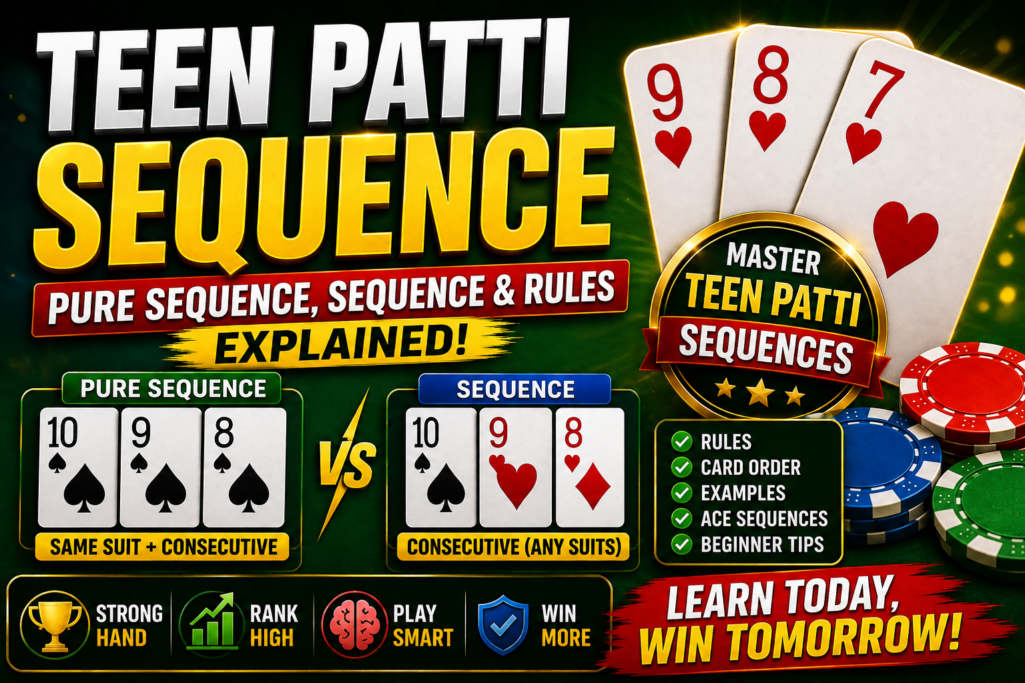
Understanding the Teen Patti sequence is essential for anyone learning 3 Patti. Sequences are among the most important card combinations in the game, and knowing the difference between a Pure Sequence and a regular Sequence can help beginners correctly identify their hands.
In standard Teen Patti, players receive three cards. These cards can form several combinations, including Trail, Pure Sequence, Sequence, Colour, Pair and High Card.
This guide focuses specifically on sequences: what they are, how they work, how Pure Sequence differs from Sequence, how cards are compared and what beginners should know about Ace combinations.
Important: Teen Patti rules can vary between apps and special game modes. Always check the specific rules displayed by the game you are playing.
What Is a Sequence in Teen Patti?
A Sequence is a three-card combination in which the card ranks follow a consecutive order.
For example:
9♠ 8♥ 7♦
The cards are consecutive:
9 → 8 → 7
Therefore, they form a Sequence.
The cards do not necessarily need to belong to the same suit.
What Is a Pure Sequence in Teen Patti?
A Pure Sequence is a sequence in which all three cards belong to the same suit.
For example:
9♥ 8♥ 7♥
These cards satisfy two conditions:
- They are consecutive.
- They are all Hearts.
Therefore, the hand is a Pure Sequence.
A Pure Sequence is generally stronger than an ordinary Sequence in standard Teen Patti.
Pure Sequence vs Sequence
This is one of the most common questions beginners ask.
| Feature | Pure Sequence | Sequence |
|---|---|---|
| Three cards | Yes | Yes |
| Consecutive ranks | Yes | Yes |
| Same suit required | Yes | No |
| Standard ranking | Higher | Lower |
| Example | 9♥ 8♥ 7♥ | 9♠ 8♥ 7♦ |
The easiest way to remember the difference is:
Pure Sequence = consecutive + same suit
Sequence = consecutive + suits can differ
Examples of Pure Sequences
Here are several examples:
Example 1
10♠ 9♠ 8♠
All three cards are consecutive and all are Spades.
Result: Pure Sequence
Example 2
7♥ 6♥ 5♥
The ranks are consecutive and all cards are Hearts.
Result: Pure Sequence
Example 3
K♦ Q♦ J♦
The cards are consecutive and belong to the same suit.
Result: Pure Sequence
Examples of Regular Sequences
Now consider:
10♠ 9♥ 8♦
The ranks are consecutive, but the suits are different.
Result: Sequence
Another example:
7♣ 6♦ 5♠
Again, the ranks are consecutive.
Result: Sequence
What Is Not a Sequence?
Not every three-card combination with similar values is a sequence.
For example:
10♠ 8♥ 7♦
This is not a normal sequence because the ranks are not consecutive.
The missing 9 means the cards do not form a standard consecutive run.
Similarly:
K♠ 10♠ 9♠
is not a Pure Sequence because the ranks are not consecutive.
The cards are the same suit, but they do not form a sequence.
Why Is Pure Sequence Stronger?
In the standard Teen Patti ranking system, a Pure Sequence ranks above an ordinary Sequence.
The common order is:
Trail → Pure Sequence → Sequence → Colour → Pair → High Card
Therefore:
Pure Sequence > Sequence
For example:
Player A: 9♥ 8♥ 7♥
Player B: 9♠ 8♥ 7♦
Player A has a Pure Sequence.
Player B has a regular Sequence.
Under standard rules:
Player A wins.
How to Identify a Teen Patti Sequence
When you receive three cards, use these simple steps.
Step 1: Look at the Card Values
Check the numerical or face-card order.
For example:
8, 7, 6
These are consecutive.
Step 2: Check the Suits
If all three cards have the same suit, you have a Pure Sequence.
If they have different suits but remain consecutive, you have a regular Sequence.
Step 3: Check for Another Higher Combination
Some combinations may qualify as a different hand depending on the exact cards and rules.
For example, three cards of the same rank form a Trail rather than a Sequence.
Teen Patti Card Order
Understanding card order makes sequences much easier to identify.
The commonly used card hierarchy is:
A → K → Q → J → 10 → 9 → 8 → 7 → 6 → 5 → 4 → 3 → 2
However, the treatment of Ace in special sequences can vary between Teen Patti versions.
Therefore, don’t assume that every possible Ace combination is treated identically across all apps.
Ace in Teen Patti Sequences
The Ace can create confusion for beginners.
In many card games, Ace can have different roles depending on the sequence.
Teen Patti implementations may use specific rules for Ace combinations.
For example, some versions recognize particular high or low Ace sequences, while others may handle them differently.
Because of this, check the rules of the specific table before assuming that an Ace can be placed anywhere in a sequence.
Can Ace, King, Queen Be a Sequence?
A combination such as:
A♠ K♠ Q♠
is commonly treated as a high sequence in many Teen Patti rule sets.
If all three cards have the same suit, it can qualify as a Pure Sequence under those rules.
However, specific Ace-sequence rules can vary between platforms.
Can 3, 2, Ace Be a Sequence?
This is an important variation-specific question.
Whether:
3-2-A
qualifies as a sequence depends on the rules being used.
Some Teen Patti variations recognize particular Ace-low combinations, while others may not.
Therefore, the safest approach is to check the rules provided by your specific game.
Pure Sequence Examples With Face Cards
Face cards can also form sequences.
For example:
K♥ Q♥ J♥
forms a Pure Sequence.
Another example:
Q♣ J♣ 10♣
also forms a Pure Sequence.
These combinations follow consecutive card values and use the same suit.
Mixed-Suit Sequence Examples
A regular Sequence does not require matching suits.
For example:
K♠ Q♥ J♦
is a Sequence if the game’s standard sequence order recognizes these cards as consecutive.
Another example:
6♣ 5♥ 4♦
is also a Sequence.
The important factor is the consecutive ranking.
Same-Suit Cards That Are Not a Sequence
This is another common beginner mistake.
Suppose you receive:
A♠ 9♠ 4♠
All three cards are Spades.
But they are not consecutive.
Therefore, this is generally a Colour, not a Pure Sequence.
Similarly:
K♥ 8♥ 3♥
is a same-suit combination but not a Pure Sequence.
Sequence vs Colour
The difference is straightforward.
Sequence
Cards are consecutive.
Example:
8♠ 7♥ 6♦
Colour
Cards have the same suit but aren’t consecutive.
Example:
A♥ 9♥ 4♥
In standard Teen Patti:
Sequence > Colour
Pure Sequence vs Colour
A Pure Sequence satisfies both conditions:
- Same suit
- Consecutive ranks
A Colour satisfies only the same-suit condition.
For example:
8♣ 7♣ 6♣
= Pure Sequence
While:
A♣ 9♣ 4♣
= Colour
Therefore, a Pure Sequence normally ranks higher.
Sequence vs Pair
A Sequence is generally stronger than a Pair.
For example:
8♠ 7♥ 6♦
is a Sequence.
K♠ K♦ 4♥
is a Pair.
Under the standard ranking:
Sequence > Pair
Sequence vs Trail
A Trail is generally stronger than a Sequence.
For example:
Q♠ Q♥ Q♦
is a Trail.
10♠ 9♥ 8♦
is a Sequence.
The Trail ranks higher.
How Do You Compare Two Sequences?
If two players both have Sequences, their relative strength is generally determined by the ranking of the sequence according to the applicable rules.
For example:
Player A: 10♠ 9♥ 8♦
Player B: 8♣ 7♥ 6♦
Player A has the higher sequence.
Therefore, Player A would generally have the stronger hand.
Specific Ace-related sequences should be evaluated according to the table’s rules.
How Do You Compare Two Pure Sequences?
The same general principle applies to Pure Sequences.
Suppose:
Player A: 10♥ 9♥ 8♥
Player B: 8♠ 7♠ 6♠
A has the higher sequence.
Therefore, Player A generally has the stronger Pure Sequence.
Can Two Players Have the Same Sequence?
Yes.
Depending on the cards and suits, two players can have sequences of the same rank.
For example, different suits could produce equivalent sequences.
The applicable rules determine how such situations are resolved.
Some platforms may use additional tie-breaking rules or suit conventions.
Always check the specific game’s rules rather than assuming that every app handles ties identically.
Common Teen Patti Sequence Mistakes
Mistake 1: Thinking Same Suit Means Pure Sequence
It doesn’t.
The cards must also be consecutive.
Mistake 2: Thinking Consecutive Cards Must Have the Same Suit
They don’t need to for a regular Sequence.
Mistake 3: Confusing Colour With Pure Sequence
A Colour has the same suit but doesn’t form a sequence.
Mistake 4: Ignoring Ace Rules
Ace combinations can vary between rule sets.
Mistake 5: Assuming Poker Sequence Rules Are Identical
Teen Patti has its own rules and variations.
Quick Way to Recognize a Pure Sequence
Use this simple test:
Are the cards consecutive?
If no → Not a Sequence.
If yes → continue.
Are all three cards the same suit?
If yes → Pure Sequence
If no → Sequence
This two-question method makes identifying most basic combinations very easy.
Teen Patti Sequence Cheat Sheet
| Cards | Result |
|---|---|
| 10♥ 9♥ 8♥ | Pure Sequence |
| 9♠ 8♥ 7♦ | Sequence |
| K♣ Q♣ J♣ | Pure Sequence |
| K♠ Q♥ J♦ | Sequence |
| A♥ 9♥ 4♥ | Colour |
| K♠ K♥ 5♦ | Pair |
| A♠ 10♥ 4♣ | High Card |
Sequence Rules for Beginners
If you’re new to Teen Patti, remember these five points:
- A Sequence contains three consecutive cards.
- A Pure Sequence also requires the same suit.
- Pure Sequence normally ranks above regular Sequence.
- Sequence normally ranks above Colour.
- Ace combinations can depend on the particular rules.
How Sequence Fits Into Teen Patti Hand Rankings
Sequences are part of the six standard hand categories.
The general order is:
1. Trail / Trio
Three cards of the same rank.
2. Pure Sequence
Three consecutive cards of the same suit.
3. Sequence
Three consecutive cards.
4. Colour
Three cards of the same suit.
5. Pair
Two cards of the same rank.
6. High Card
No higher combination.
For the complete explanation of every category, read our Teen Patti Hand Rankings guide.
How Sequence Works in Online Teen Patti
Online Teen Patti apps automatically identify and display many aspects of your hand.
Depending on the platform, the game may show:
- Your three cards
- Current hand type
- Betting options
- Pot size
- Player turns
- Available actions
However, you should still understand the ranking yourself.
Don’t rely completely on visual labels, especially when moving between different apps or variations.
Teen Patti Sequence in Different Game Modes
Special Teen Patti modes can modify the normal rules.
Examples include:
- Joker
- Muflis
- AK47
- Royal
- Other platform-specific modes
A Joker variation can change how cards combine.
Muflis can reverse or modify normal hand strength.
Other modes may introduce special cards.
Therefore, the standard sequence rules explained in this article should primarily be used for Classic Teen Patti unless the particular game states otherwise.
Is Pure Sequence the Best Hand?
No.
In standard Teen Patti, a Trail or Trio is generally ranked above a Pure Sequence.
The usual order is:
Trail > Pure Sequence > Sequence
For example:
A-A-A
normally beats:
K-Q-J of the same suit
if both are evaluated under standard Teen Patti rules.
Is Sequence Better Than Colour?
Yes, under the standard ranking system.
A regular Sequence generally ranks above a Colour.
For example:
9♠ 8♥ 7♦
is stronger than:
A♥ 9♥ 4♥
under the standard hand ranking.
Is Pure Sequence Better Than Sequence?
Yes.
A Pure Sequence has the additional requirement that all three cards belong to the same suit.
For example:
9♥ 8♥ 7♥
beats a regular:
9♠ 8♥ 7♦
when comparing the same sequence ranks under standard rules.
Practice Examples
Try identifying these hands yourself.
Hand A
8♥ 7♥ 6♥
Answer: Pure Sequence
Hand B
8♠ 7♥ 6♦
Answer: Sequence
Hand C
A♣ 10♣ 4♣
Answer: Colour
Hand D
Q♠ Q♥ 3♦
Answer: Pair
Hand E
A♦ A♣ A♥
Answer: Trail
Hand F
K♠ 9♥ 4♦
Answer: High Card
Practicing examples like these is one of the easiest ways to memorize Teen Patti hands.
Teen Patti Sequence Strategy: What Beginners Should Know
A sequence can be a strong hand, but having one does not guarantee that you will win.
Another player could have:
- A higher Sequence
- A Pure Sequence
- A Trail
or another stronger combination according to the applicable rules.
Therefore, don’t assume that seeing a Sequence automatically means the round is won.
If the game involves real-money stakes, remember that outcomes remain uncertain.
Responsible Play
Teen Patti can be played for entertainment, but some platforms may offer real-money wagering.
If you choose to play such games:
- Understand the rules first.
- Check whether real-money play is legal where you live.
- Set a personal budget.
- Never chase losses.
- Don’t borrow money to play.
- Take breaks.
- Never treat winnings as guaranteed income.
The strength of a Sequence tells you about your cards; it does not guarantee a particular financial outcome.
Frequently Asked Questions
What is a Sequence in Teen Patti?
A Sequence is a three-card combination containing consecutive card ranks. The cards do not have to belong to the same suit.
What is a Pure Sequence?
A Pure Sequence contains three consecutive cards that all belong to the same suit.
Which is higher: Sequence or Pure Sequence?
A Pure Sequence is generally higher than a regular Sequence in standard Teen Patti.
Is Colour higher than Sequence?
No. In standard Teen Patti, Sequence ranks above Colour.
Is Pure Sequence the highest Teen Patti hand?
No. A Trail or Trio is generally the highest standard hand.
Can cards of different suits form a Sequence?
Yes. A regular Sequence can contain cards from different suits.
Do all cards need the same suit for a Pure Sequence?
Yes. All three cards must belong to the same suit.
Are three cards of the same suit always a Pure Sequence?
No. They must also be consecutive. Otherwise, they are generally a Colour.
Can A-K-Q form a Sequence?
Many standard Teen Patti rules recognize A-K-Q as a high sequence, but specific implementations can differ.
Can 3-2-A form a Sequence?
This depends on the particular Teen Patti rules. Ace-low sequence treatment varies between versions.
What comes after Pure Sequence?
In the standard ranking, a regular Sequence comes after Pure Sequence.
Can a Trail beat a Pure Sequence?
Yes. A Trail or Trio generally ranks above a Pure Sequence.
How do I memorize Teen Patti sequences?
Remember:
Consecutive + same suit = Pure Sequence
Consecutive + different suits allowed = Sequence
Do online Teen Patti games use the same sequence rules?
Not necessarily. Different apps and game modes can modify the rules, so always check the instructions for the specific table.
Final Teen Patti Sequence Guide
The most important thing to remember is that there are two basic types of sequences in standard Teen Patti:
Pure Sequence
Three consecutive cards + same suit
Example:
10♥ 9♥ 8♥
Sequence
Three consecutive cards + suits do not need to match
Example:
10♠ 9♥ 8♦
The standard ranking places:
Trail → Pure Sequence → Sequence → Colour → Pair → High Card
Once you understand this structure, identifying most basic Teen Patti hands becomes much easier.
If you are still learning the game, read our Teen Patti Rules guide for the complete gameplay process and our Teen Patti Hand Rankings guide for a full explanation of all hand categories.
Final Thoughts
The Teen Patti sequence is one of the most important concepts for beginners to understand.
A regular Sequence requires three consecutive cards, while a Pure Sequence requires three consecutive cards of the same suit. Pure Sequence is generally stronger than an ordinary Sequence, and both are stronger than Colour, Pair and High Card in the standard ranking.
Before playing any online version, remember that special modes can change the normal rules. Always read the table instructions and understand the applicable rules before making decisions.
Learn the cards first, understand the rules, and play responsibly.